AI agents for bequest administration.
AI agents that route estate documents, extract verifiable gift data, and validate historical terms, reducing hours of review to minutes.
How it works
We automate the process. You focus on higher-value work.
The most time-consuming parts of estate administration: routing wills, extracting cited terms, and validating historical restrictions, all handled automatically. Three agents run today, live, on every document. More join the corpus as we build.
Intake Agent
Live TodayIdentifies what kind of document just arrived, whether a will, a codicil or an executor's accounting, and routes it to the right case.
Reader Agent
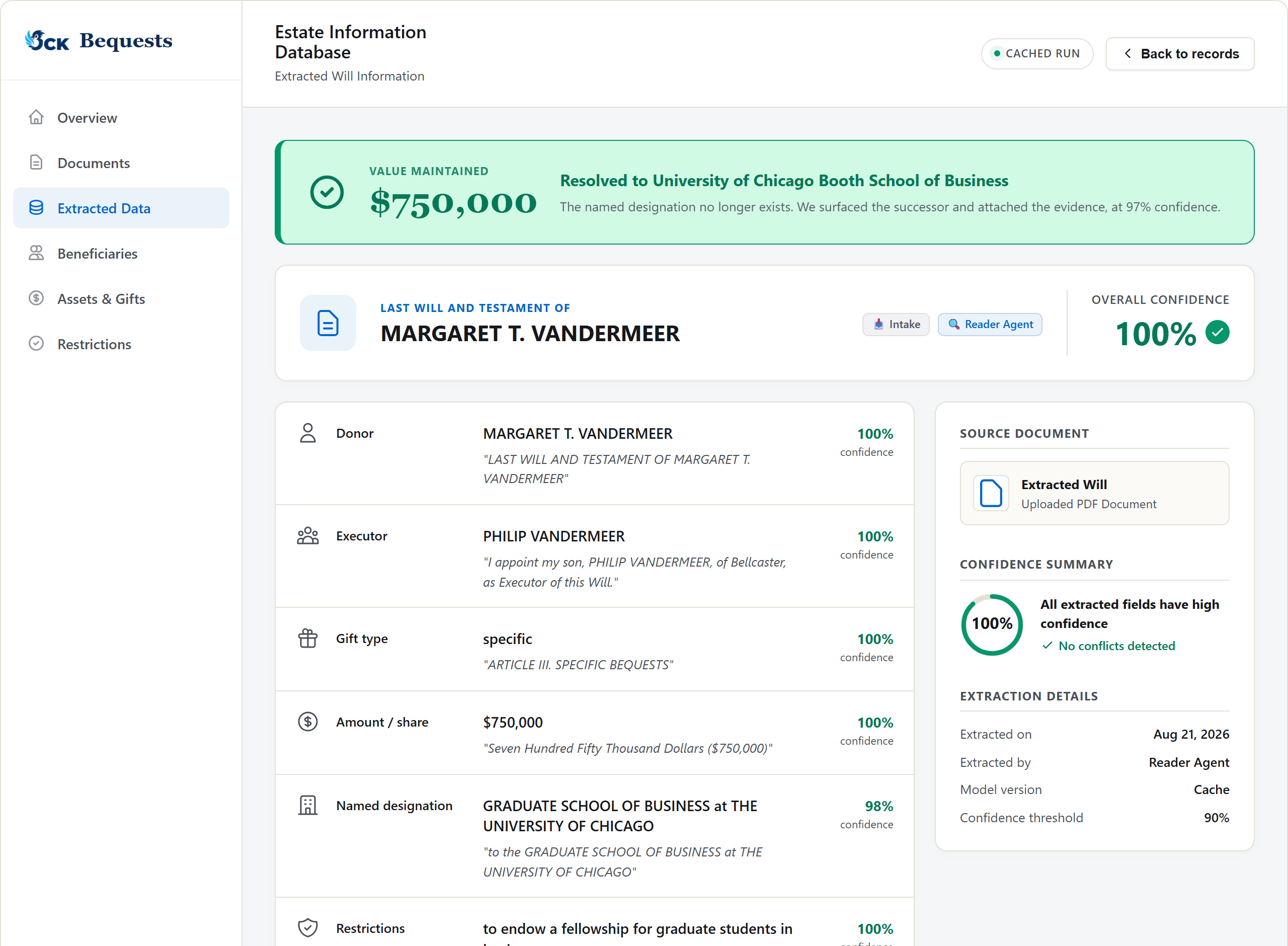
Live TodayExtracts donor, executor, gift type, amount or share, named designation, restrictions and dates, with a confidence score and the exact source sentence for every field, so nothing is a black box.
Restriction Agent
Live TodayAsks one question. Does this restriction still work? Matched against our historical entity map, with the archive evidence chain attached. A curated map, never a model guess.
Coming next: roadmap, not yet built
Matcher Agent
Finds the deceased in the CRM despite name and address drift.
Linker Agent
Given an entity or change event, returns every instrument referencing it.
Probate Agent
Watches probate registries and death notices, and matches them against the institution's own history.
Watcher Agent
Reads the institution's published changes, including mergers, closures and renames, and flags every instrument each one touches.
Dormancy Agent
Screens the standing endowment corpus for funds whose purpose no longer maps to anything the institution does.
Asset Verification Agent
Reads an executor's interim accounting and checks it against what actually arrives.
The demo
A resolved restriction, with evidence, in under a minute.
Live, not a mock-up. An AI language model reads every document below and returns every field scored, with the sentence it came from. Scans go to an AI vision model.
Every gift, tracked from will to distribution
Securing the gift, from probate to perpetuity.
We provide comprehensive oversight, ensuring funds are tracked accurately, verified upon receipt, and applied correctly at every stage of the endowment's life.
At administration
We verify the money actually arrives, on time and in full.
Across the endowment's life
Institutions evolve. Faculties merge, programs close. The original gift terms do not. We monitor their published changes against every gift agreement they hold, and protect the money two ways.
Forward
Catch mismatches before funds are misapplied. A loss prevented.
Backward
Find funds already stranded, sometimes for decades, and redirect them to the closest active program the institution still runs. Cash unstuck. Nobody re-checks these. We do.
Honor every donor's intent, decades later.
Most advancement software stops tracking when a will is signed. We ensure the gift actually fulfills its purpose. By automatically mapping historical gift terms to your modern institution, we ensure that a 1994 bequest safely reaches its successor, and that dormant funds untouched for decades are finally put to work.
Money saved and made
And the numbers behind them.
Time saved
Hours become minutes.
Where the 120 files a year comes from
Roughly 1,840 working hours a year against 8-15 hours per restricted file is a hard ceiling of about 120-230 files a year, and that assumes an officer does nothing else.
Pricing
Transparent pricing, flat subscriptions.
Small College
- Annual subscription
- Scaled to instruments monitored
- Protect restricted funds
Large University
- Full estate monitoring suite
- Historical entity tracking
- Protect outstanding bequest intentions
Largest Endowments
- Highest-volume monitoring capacity
- Corpus-wide dormancy screening
- Enterprise integration
Team

Matthew
Legal Engineer, Master of Laws
Legal researcher on wills and bequests, University of Sydney Advancement Services and Office of General Counsel. Founding engineer at Fluent Forever (0 to $2.5M ARR).

Phuong
Product Designer, Bachelor of Social Work
UNSW Centre for Social Impact. Specializing in ethical data administration and blending inclusive UX/UI design with deep empathy to drive meaningful social impact outcomes.